Learning to Make Traditional Willow Hoops
One of the biggest challenges I’ve faced while learning the craft of coopering isn’t shaping the staves or cutting the croze—it’s making the hoops that hold everything together.
Over the years I’ve experimented with just about every modern solution I could think of: embroidery hoops, oak hoops, metal strapping, leather belts, ratchet straps, and untapered steel hoops. They all work to some degree, but none truly capture the methods that historical coopers would have relied upon.
Popular media has led many people to believe that wooden buckets and barrels have always been bound with iron hoops. In reality, that’s only part of the story. Before iron hoops became widespread during the medieval period, coopers often relied on natural materials such as split willow, hazel, withies, or other flexible woods to bind buckets and casks together. These materials required considerable skill to prepare, but they were readily available and remarkably effective.
For finished buckets, I’ve occasionally used reed purchased from a chair caning supplier. It certainly looks the part, but I’ve found it lacks the strength needed during the actual construction process.
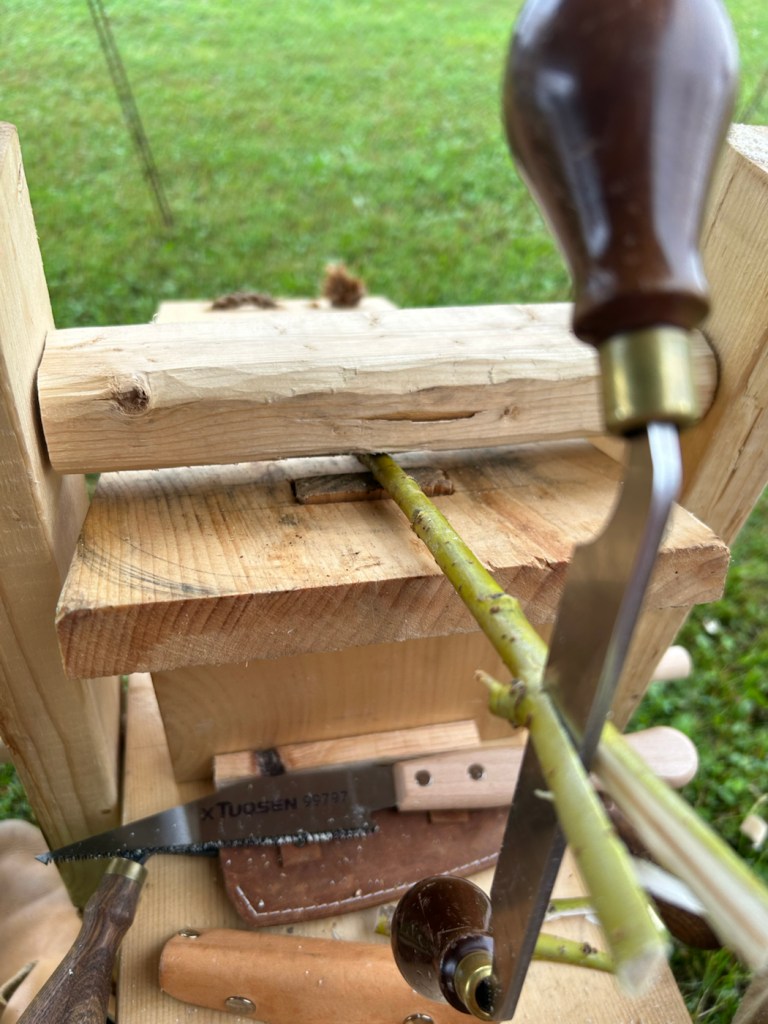
This past weekend, while attending an SCA event, I decided it was finally time to try making my own willow hoops.
Armed with green willow branches, I attempted to split them into long, flexible strips. I understood the theory, but quickly discovered that understanding a technique and having the proper tools are two very different things.
Although I managed to split several branches, this first attempt produced only short lengths—far too short to wrap around a bucket. Still, every unsuccessful attempt teaches something valuable. I’ll chalk this one up as another lesson on my journey as an apprentice cooper.
Reflecting on the experience afterward, I began thinking about what the ideal tool might look like.
My idea is surprisingly simple: a flat board secured in my shavehorse, with a sharp knife mounted upright in the center, the cutting edge facing away from me. By carefully starting a split in the end of a green willow rod, I could feed it over the knife and pull the branch toward myself, guiding each half with my hands as it naturally divides. If everything goes according to plan, each rod should split into two long, usable lengths suitable for hoop making.
As it turns out, this isn’t a new idea at all.
Historical research shows that this traditional process is known as skeining, and the specialized tool used is called a willow splitter. Like so many traditional woodworking techniques, generations of craftspeople had already solved the problem centuries before I encountered it.
Now I have two new projects ahead of me: build a proper willow splitter and practice the art of skeining until I can consistently produce long, strong hoops.
Sometimes the greatest lesson isn’t that a method doesn’t work—it’s discovering why skilled craftspeople developed specialized tools in the first place.
Every failed attempt brings me one step closer to understanding the craft.

